

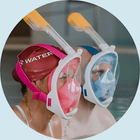



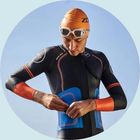
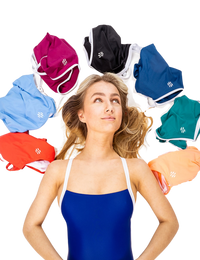
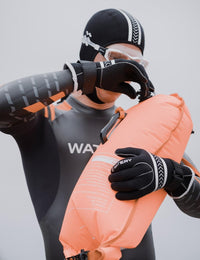








We - from Watery - have gathered the best from our own experiences with open water swimming in this guide. Sea swimming has become popular, and we want to help you get started on the right foot.
The guide on this page covers:
- Equipment - what you need for open water swimming and why
- Preparation - how to build your foundation in the pool
- Safety - the rules you should never compromise on
- Uncomfortable situations - and how to avoid them
- Training programs - for those who want to excel in open water swimming
Briefly explained: What is open water swimming really?
Open water swimming is swimming in natural surroundings - sea, lakes, fjords, and the like - without the edges, bottom markers, and heaters you know from the swimming pool. In other words, you swim in open, natural water.
A regular pool is controlled and predictable. Open water is alive. You navigate by buoys and coastlines, breathe to your "bad" side when the waves dictate it, and often swim shoulder to shoulder with other swimmers in competitions. It's this combination of exercise, nature, and a little bit of adventure that makes it so appealing to many.
However, it requires that you are prepared and have the right equipment. And that's exactly the purpose of this guide.
Best equipment for sea swimming - you MUST have this
Equipment for open water swimming can be a bit of a science in itself. Should the goggles be polarized or not, is 5 mm neoprene around the shoulders in the wetsuit too much, and how do you best take care of your newly purchased equipment? We give you a few tips and tricks based on our own experiences.
The bag should - at a minimum - contain:
- Swimwear - either swimsuit or swim trunks - to wear under the wetsuit
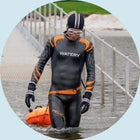
- Wetsuit - can be omitted when swimming in warmer water, but recommended until 15-20 degrees. The purpose of a wetsuit is not only to keep you warm but also to provide extra buoyancy and safety.
- Goggles for open water - type depends on the weather and preferences
- Swim cap - lots of colors. Preferably choose green, red, yellow, or orange, and avoid black, gray, and dark blue as these are not visible enough on the water
- Safety Buoy - a colorful inflatable buoy you strap around your waist. Typically also functions as a sea bag for keys and phone
- Towel or bath poncho - it's nice to wrap up well afterward
- Vaseline or cream - apply under arms and around the neck to avoid the worst chafing, especially in saltwater
- Earplugs for swimming - cold water in the ears can cause severe headaches


How to choose the right wetsuit
The most important equipment for sea swimming is definitely the wetsuit. And it's important that you choose the right one and in the right size.
A wetsuit should fit a bit snug the first time it's worn - the neoprene will give with use. However, it must not be loose under the arms or in the crotch, as these air pockets fill with water and make the suit loose around the torso (chest). This will result in it feeling less warm and more uncomfortable to wear.
Another thing to be aware of is the thickness of the wetsuit's panels. A wetsuit is divided into different sections with different neoprene thicknesses. Typically, a wetsuit will have 5 mm neoprene on the chest and thighs for buoyancy and warmth, 3 mm on the arms and legs, and 2 mm around the shoulders for good mobility.


If you want to dive into the world of wetsuits and REALLY find out which one is right for you, read our in-depth guide here 👇:
Goggles for sea swimming
Goggles are not just goggles - especially when it comes to open water swimming.
There are different types of lenses for goggles, and you choose based on your needs.
If it's overcast and not so bright, it doesn't make sense to wear a pair of mirror goggles - here goggles with clear lenses would be preferable. If the sun is shining from a clear sky, mirror goggles are almost a must.
If you're a bit of a gear nerd, polarized goggles are probably the best choice. The polarized lens doesn't let horizontal light rays - that is, glare from the water surface - penetrate, making it easier for you to orient yourself in the water.


Click the button for more specific recommendations on goggles for open water: 👇
Preparation for sea swimming - "how to train yourself ready"
"Swimming is just swimming" is a classic we often hear - but open water swimming requires a bit more respect and adaptation to the water you will swim in.
So without scaring anyone away, one of the significant differences is the increased risk that comes with swimming in an unbounded area. It's a factor you need to be aware of.
If you want to prepare for an open water event - or just have a good experience on your first trip to the sea - it's a really good idea to refine your skills in the pool first.
We've gathered the skills we find most necessary:
- Be comfortable during your swim. Try to achieve a relaxed swimming style so you don't use unnecessary energy.
- Learn more than one stroke. Most swim freestyle in open water, but practice either breaststroke or backstroke so you can always vary when tired.
- Swim longer distances in the pool. Most open water events are over one kilometer - you should at least be able to swim that distance in the pool without a break.
- Tread water. In the pool, you can always put a foot on the bottom or quickly swim to the edge. You can't always do that outdoors. Practice treading water so you can rest your arms along the way.
- Breathe to both sides while swimming freestyle. In open water, the waves can force you to breathe to your "bad" side - so practice freestyle to both sides.
- Swim in groups. At the start of open water races, you typically lie VERY close. Shoulder to shoulder with other swimmers - and it takes some getting used to. Practice it in the pool so it doesn't come as a shock, otherwise, it can be quite overwhelming.
If you practice these skills before your first trip to the sea, the likelihood of a good experience is significantly higher - we guarantee it.
Acclimatization to cold water - avoid cold water shock
In open water, you obviously can't control the water temperature. This means you really need to train to swim in colder water. But don't worry: Cold water is not dangerous, you just need to learn to handle it correctly.
The water temperature in Irish waters rarely gets much more than 20 degrees, and the body reacts instinctively: You breathe in quickly, start to hyperventilate, and tense up all over.
This is precisely the reaction you want to avoid before your swim.
Try to relax. Feel how the water presses on the wetsuit, and notice where the water seeps in - because it does, and it can't be avoided.
Practice keeping your breathing controlled and calm.
And typically after about a minute, when you feel relaxed, you can start swimming.
We've found that it's a technique that takes a bit of time to learn, but once you get used to handling the cold water, it makes a huge difference in your open water swimming.
The discount code can be used by all new customers on all products on the website, including the products recommended here in the article. What are you waiting for? Get more out of your time in and on the water!

GET A DISCOUNT CODE WITH 10% OFF
Safety in sea swimming: 5 important rules you must always follow
Open water swimming can bring lots of joy to everyone who takes it up. But it requires that safety is in place. And in this regard, there are 5 rules that we always recommend you follow - whether you're a beginner or an experienced swimmer.
- Never swim alone. This is the most important rule. If an accident happens in the water, you depend on others to help you - or call for help. Always take a friend with you, or find a local swimming group.
- Prepare in the pool first. Open water is more demanding than a pool. Make sure you're comfortable swimming longer distances before you venture into the sea.
- Be visible in the water. Use a colorful swim cap (green, yellow, orange, or red) and a Safety Buoy. A swimmer without visible marking is hard to spot - both for rescuers and for boats and jet skis nearby.
-
Avoid shipping lanes and busy areas. Even if you use a Safety Buoy + colorful swim cap, you're not very visible from a motorboat approaching at high speed.
So stick to "calm areas" and check which parts of your swimming route are busy. - Know the local currents and weather conditions. Wind, current, and weather can change quickly. Familiarize yourself with the conditions before you go in the water - and turn back if the weather suddenly changes.
A good extra tip: Swim along the coast, so you never move further from land than you can comfortably swim back. This gives you a natural safety margin.
If you want to know more about safety in and around water, TrygFonden has the campaign Respect for Water, where they regularly share good advice and tips.
Practical tips for a great experience
We've already covered equipment, preparation, and safety. But there are still a few things that can ruin an otherwise good swim - and we want to help you avoid them.
1. Manage your energy correctly from the start
As in all other endurance sports, it's important to manage your energy wisely. This is especially true in open water because you can't just stop and rest at the edge.
Even if you're a bit cold and want to get started quickly, it pays to start out controlled for the first few minutes. If you start too quickly, you build up an oxygen debt (a state where the muscles lack oxygen and accumulate waste products) in the body, which is difficult to get rid of again.
And this will result in your swimming pace dropping, and the body won't be able to recover until you significantly reduce the speed.
Start slowly. Build up gradually. Our best recommendation.
2. Train with a wetsuit before competition or long trips
If you're going to swim an open water competition in a wetsuit, it's important to get as many hours as possible in the suit - both indoors and outdoors - before the big day.
Neoprene around the shoulders is limiting for your freedom of movement.
It takes extra energy to swing your arms around, and it doesn't feel it in the first many minutes - but gradually the muscles get tired, and the technique begins to fall apart.
So we recommend that you train a good deal with your wetsuit so you can get used to the extra resistance.
3. Avoid chafing with the right lubricant
Chafing is one of the most annoying side effects after a trip in the wetsuit - but they are fortunately easy to prevent.
Apply vaseline or a special open water cream (can be purchased here) on the areas where the suit chafes: This will typically be the neck, under the arms, and at the thighs.
If your suit fits correctly, you can easily swim shorter trips without problems - but on long trips and swimming in saltwater, you can hardly avoid getting chafing if you haven't applied friction cream.
4.88/5
Based on 8 reviews

Watery Friction Cream against chafing - Swimmers
4. Choose the right place to swim
If you have the option to choose between several different places to swim, choose the place where the wind blows towards the coast (onshore wind) rather than away from the coast (offshore wind).
- Offshore wind pulls the warm surface water away from the coast, and the cold water from the bottom rises and brings the characteristic jellyfish with it. This makes the water colder and significantly harder to swim in.
Moreover, it's much safer to swim with onshore wind because you don't risk being pulled away from the coast.
Training program for open water swimming
We've created two weekly plans for you:
- one for you who wants to complete your first open water event at 2,500 m
- and one for you who wants to swim a fast 5,000 m.
Both programs include three training sessions a week. The days on the left side are not fixed, but we recommend that you at least take one day's break between each session.
We use some abbreviations in the programs - e.g., p.30, which means pause 30 seconds.
If something seems unclear, you're always welcome to contact us, and we'll explain it further.
Weekly training plan - complete your first 2,500 m
Monday/Tuesday: High intensity
200 m freestyle p.15
100 m kick p.15
200 m freestyle p.15
100 m backstroke p.15
4x50 m progressive 1-4 with good pause - there should be a clear difference in the four 50 meters.
3 rounds of:
200 m freestyle at a relaxed pace (30 sec pause)
100 m freestyle at a hard pace (30 sec pause)
50 m freestyle as fast as possible (15 sec pause)
50 m backstroke + 1-minute pause
200 m (50% freestyle, 50% backstroke)
Total: approx. 2,200 m
Wednesday/Thursday: Sprint and technique
15 min optional warm-up
2 rounds of:
4x25 m freestyle - 25 m right arm, 25 m left arm
50 m freestyle with clenched fists (forces you to use your forearms more actively)
100 m freestyle - focus on long strokes
5x100 m freestyle p.30 - moderately hard pace with focus on maintaining good technique rather than speed.
3 rounds of:
50 m freestyle hard pace p.15
25 m all-out p.20
25 m relaxed swimming p.30
200 m cool down with focus on technique.
Total: approx. 2,000 m
Saturday: Distance training
5x100 m alternating freestyle and backstroke
12x25 m freestyle - 3 rounds of (left arm / right arm / clenched fists / normal freestyle) p.10 sec
6x50 m progressive 1-3 p.20
5 rounds of:
100 m freestyle easy p.15
100 m freestyle medium p.15
50 m freestyle hard p.10
200 m backstroke
Total: approx. 2,800 m
| Day | Focus | Key exercises | Total distance |
|---|---|---|---|
| Monday / Tuesday | High intensity | Progressive pace, alternating styles, 3 interval sets | approx. 2,200 m |
| Wednesday / Thursday | Sprint and technique | One-arm freestyle, clenched fists, short sprints | approx. 2,000 m |
| Saturday | Distance | Long series, alternating styles, 5 interval sets | approx. 2,800 m |
Weekly training plan - set a personal record at 5,000 m
Monday/Tuesday: High intensity
200 m freestyle, 200 m backstroke, 200 m kick, 200 m backstroke, 200 m freestyle
20x25 m freestyle - 5 rounds of (left arm / right arm / clenched fists / normal freestyle) p.10 sec
3x100 m progressive 1-3 with focus on long strokes.
5 rounds of:
200 m freestyle at a relaxed pace (30 sec pause)
100 m freestyle at a hard pace (15 sec pause)
50 m freestyle as fast as possible (directly to backstroke)
50 m backstroke + 1-minute pause
200 m backstroke
Total: approx. 4,000 m
Wednesday/Thursday: Sprint and technique
15 min optional warm-up (preferably 800-1,000 m)
4 rounds of:
4x25 m freestyle - 25 m right arm, 25 m left arm
50 m freestyle with clenched fists
100 m freestyle - focus on long strokes
50 m backstroke
5x200 m freestyle p.30 - moderately hard pace with focus on technique.
6 rounds of:
75 m freestyle hard pace p.15
25 m all-out p.20
50 m relaxed swimming p.30
500 m cool down (100 freestyle / 100 backstroke / 100 kick / 100 freestyle / 100 backstroke)
Total: approx. 4,500 m
Saturday: Distance training
500 m (200 freestyle, 100 backstroke, 200 freestyle)
5x100 m kick p.30 sec
6x50 m progressive 1-3
2 rounds of:
100 m freestyle at your 5,000 m pace (e.g., 1.20 per 100 m)
200 m freestyle - 2.40
300 m freestyle - 4.00
400 m freestyle - 5.20
2 rounds of (decreasing distance):
400 m freestyle - 5.20
300 m freestyle - 3.54
200 m freestyle - 2.32
100 m freestyle - 1.14
The pause on these series is your 5,000 m pace + 20 seconds. The start time in the example is thus 1.40 per 100 m. Add an extra minute's pause between the two blocks.
200 m optional cool down
Total: approx. 5,500 m
| Day | Focus | Key exercises | Total distance |
|---|---|---|---|
| Monday / Tuesday | High intensity | Progressive pace, 5 heavy interval sets, alternating styles | approx. 4,000 m |
| Wednesday / Thursday | Sprint and technique | One-arm freestyle, clenched fists, 6 sprints, long cool down | approx. 4,500 m |
| Saturday | Distance | Tempo-based series up and down in distance, kick training | approx. 5,500 m |
Injury prevention - exercises you must not skip
Swimming puts more strain on the shoulders than most other sports. The repetitive rotational movement in freestyle creates over time a natural tendency for forward shoulders and muscle imbalance - and this can lead to injuries if you don't actively prevent it.
In addition to the three weekly swim training sessions, we recommend that you spend a quarter of an hour a couple of times a week on injury prevention exercises - especially for shoulders and back.
The exercises don't need to be complicated. These are a good starting point:
- 3 - 5 days delivery, on weekdays.
- Free shipping on purchases over €79.
- Customer support from 08:00 - 22:00 on weekdays
- 100 % price match so you can get the best at the best price
Below you will find a video example of exercises we recommend becoming a regular part of your routine:
👉 See the exercises here - they counteract forward shoulders after swim training
We hope you give the programs a try - or just let yourself be inspired. The programs have all been tested in practice with good feedback. There's nothing more to say than to wish you good luck with the training.
FAQ - Frequently asked questions about sea swimming
[section=faq]

Former elite swimmer and founder of Watery.ie
Daniel has swum at an elite level and has extensive experience with open water swimming over the years. He knows exactly what separates a good experience in the sea from a bad one - and it's this knowledge that he has based this guide on. He is behind Watery.ie, where he combines his passion for swimming with expertise in equipment and advice.
Read more about Daniel and Watery here